
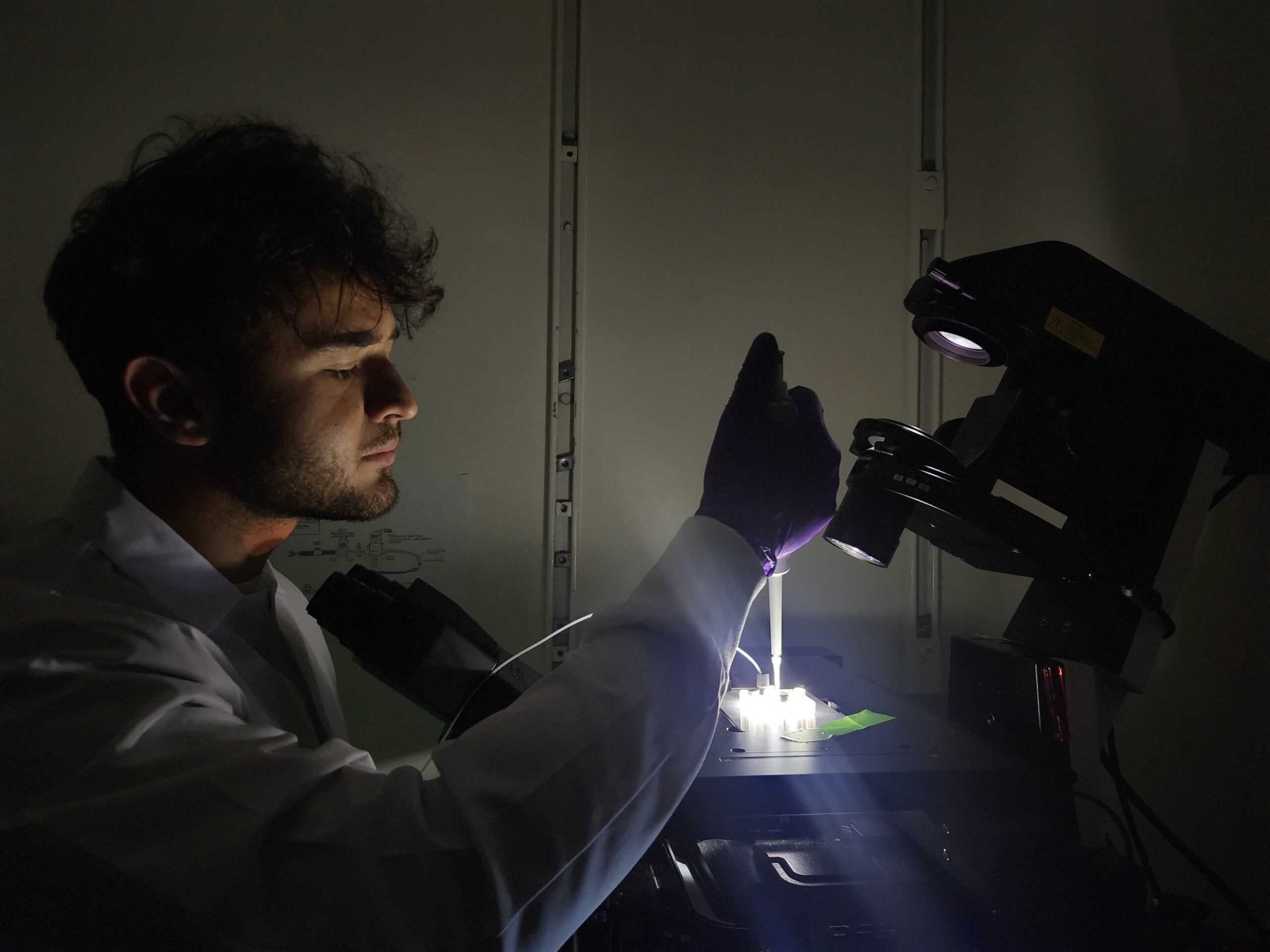
Vancouver-based ScopeSys is working to change how the next generation of genetic medicines are developed and analyzed. Their Convex Lens-induced Confinement (CLiC) technology was pioneered by ScopeSys Co-Founder and Board Director Dr. Sabrina Leslie, an Associate Professor at UBC’s Michael Smith Laboratories and lead inventor of the platform. ScopeSys gives researchers a molecular view of DNA, proteins, RNA, lipid nanoparticles (LNP), live cells, and more. ScopeSys is led by CEO Dr. Padma Kodukula, a life sciences executive with more than 27 years of experience building and commercializing platform technologies.

Dr. Padma Kodukula
The company recently announced the closing of a CAD$1.5 million (USD$1.1 million) seed financing round, supporting its transition from academia to industry. Dr. Kodukula sat down with Science in Vancouver to discuss how ScopeSys is translating academic discovery into commercial technology, the analytical gaps facing genetic medicine developers, and their vision for building a Canadian leader in nanomedicine analytics.
What research issues/gaps were you trying to address when you founded ScopeSys?
Genomic medicines—mRNA vaccines, RNA interference therapeutics, antisense oligonucleotides, gene editing, and emerging multi-payload delivery systems—have advanced extremely quickly, but the analytical tools used to characterize them have not kept pace. Conventional methods such as dynamic light scattering, bulk fluorescence assays, cryo-electron microscopy, and standard microscopy mostly report population averages or static snapshots, or require extensive sample preparation. They cannot routinely show how individual particles in a batch differ from one another.
That matters because formulations that look identical by average size or bulk encapsulation efficiency can actually contain very different subpopulations of particles—some empty, some partially loaded, some carrying multiple payloads, some structurally different in how the cargo is organized inside the lipid shell. These differences can drive potency, stability, and safety, yet they remain invisible to the tools most labs use day to day.
ScopeSys was founded to close that gap. Our CLiC platform confines freely diffusing molecules and nanoparticles in solution, without tethering them to a surface, so we can observe individual particles in real time and under near-native conditions. That gives us correlated, particle-by-particle data—size, diffusivity, payload copy number, structural organization, binding kinetics, and how particles respond as conditions change—that simply isn’t accessible with the current analytical toolkit.
How do you see ScopeSys changing drug discovery and biopharma workflows?
Single-molecule analytics for visualizing mRNA lipid nanoparticle interactions
Today, formulation development for genetic medicines is largely guided by ensemble-average measurements and a fair amount of trial and error. Our goal is to give developers a much richer, particle-resolved picture earlier in the process—so they can see, for example, what fraction of particles in a batch are actually loaded with the intended payload, whether a dual-cargo formulation is co-loading cargos into the same particle or producing separate subpopulations, and how a formulation behaves as it moves through pH changes, dilution into serum, or storage stress.
Practically, this means formulation teams can compare candidates and process conditions on dimensions that aren’t visible with conventional tools. Longer term, we also see CLiC as a way of generating the kind of rich, multi-parametric, time-resolved datasets that AI and machine-learning models need to design and predict the performance of genetic medicines.
How did the research behind ScopeSys transition from the Leslie Lab into a startup?

Dr. Sabrina Leslie
CLiC itself has a long academic history. Sabrina co-invented the underlying confinement technique at Harvard in 2009–2011, then continued developing it as a faculty member at McGill from 2012–2020 and brought her group to UBC’s Michael Smith Laboratories in 2021. Over more than a decade and 35-plus peer-reviewed publications, the Leslie Lab established CLiC as a way to study DNA, proteins, RNA, LNPs, and live cells with single-molecule and single-particle resolution. The relationship between ScopeSys and the Leslie Lab remains an active research partnership: the lab continues to push the underlying science and develop new assay capabilities while ScopeSys focuses on commercialization.
What advice do you have for researchers taking their ideas from academia to industry or trying to found their own startups?
Start with a real, unmet customer need—not just an elegant technology. CLiC is scientifically powerful, but ScopeSys’ roadmap has been shaped by direct feedback from pharmaceutical partners about the data they need to make better decisions across drug discovery and development.
Second, build a team that combines deep scientific expertise with commercial and operational experience. Turning a research platform into a product, supply chain, and sales model requires skills that are different from, and complementary to, those that created the underlying science.
Third, let the product roadmap evolve with the market. For ScopeSys, that has meant moving iteratively from services to a benchtop instrument, and eventually to a higher-throughput integrated system. Each step should be guided by customer feedback, product-market fit, and a deliberate IP strategy.
Finally, maintain a strong academic relationship. The ongoing collaboration between ScopeSys and the Leslie Lab continues to generate new science, train highly qualified personnel, and support the commercial pipeline. Ideally, academic translation should be a two-way partnership, not a one-time technology transfer.
Where do you see ScopeSys in the next five to ten years?
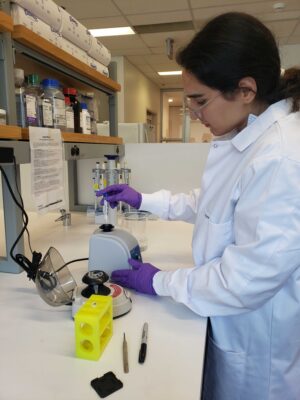 Over the next five years, we expect ScopeSys to move from a services-led company to one with an installed base of instruments and a growing menu of application-specific consumables. We also expect to become a meaningful source of structured, AI-ready datasets for biopharma partners, supporting them with formulation design, comparability and quality control, and potentially opening new business models around data and software licensing.
On the team and ecosystem side, our plan is to grow from less than 10 employees today to more than 75 over the next five years, with most of the roles based in British Columbia. We see ScopeSys as part of building a genuinely Canadian capability in genomic medicine analytics, helping make Vancouver a recognized center of excellence for nanomedicine analytics.
Looking further out, toward the ten-year horizon, our ambition is for CLiC-based analytics to be a standard part of how next-generation medicines are designed, developed, and quality-controlled with ScopeSys positioned as a long-term platform partner for every pharma, biotech, contract research organization, and academic center developing genomic and biologic medicines. Our vision is to be recognized as a world-leading analytics company that spans single molecules to single particles to single cells for all stages of drug development and fuels the data for AI-enabled drug design and development.